Seiba Risk Scanner
By Shoa A.
5 Min Read
Open source privacy risk assessment for healthcare data.
Healthcare organizations routinely prepare datasets for AI applications, analytics, research, and third-party collaboration. These datasets rarely consist of a single source. They typically combine structured records, clinical notes, referral documents, laboratory results, and years of operational data collected across multiple systems.
One of the first questions teams ask before that data moves anywhere is:
How sensitive is this data?
Today, there are excellent tools for detecting personally identifiable information (PII), protected health information (PHI), and other sensitive entities. Some also provide basic de-identification capabilities.
Detection, however, is only the beginning.
Teams still need to answer questions such as:
How severe is the privacy risk?
Which datasets, records, or fields deserve immediate review?
Where is privacy exposure concentrated?
How likely is re-identification?
Which de-identification strategy is appropriate for the intended use case?
How much analytical utility will be lost after anonymization?
Can those decisions be explained and audited later?
Detection tells you where sensitive information exists.
It does not tell you how risky that information is, how it should be treated, or whether the dataset is actually ready for downstream AI systems, analytics, or external sharing.
What is Seiba Risk Scanner?
Seiba Risk Scanner is an open source toolkit that extends sensitive data detection into a complete privacy risk assessment workflow.
Rather than stopping after identifying sensitive information, it helps organizations understand privacy exposure, prioritize remediation, generate explainable de-identification plans, execute policy-driven transformations, and measure the resulting privacy and utility outcomes.
It supports both structured datasets and unstructured clinical text, allowing privacy assessments to be performed consistently across healthcare data before it moves into AI systems, analytics pipelines, or external environments.
Where It Fits
Seiba Risk Scanner is designed for the stage after sensitive data has been detected but before the data is used or shared.
Typical workflows include:
Preparing datasets for healthcare AI applications
Building de-identified research datasets
Internal analytics and business intelligence
Data sharing with external partners
Privacy and governance reviews
Compliance readiness assessments
Dataset validation before production AI pipelines
Instead of producing only a list of detected entities, Seiba Risk Scanner helps teams answer whether the dataset is actually ready for its intended purpose.
Privacy Assessment Workflow
Every assessment follows the same workflow.
Identify → Quantify Risk → Explain → Optimize → Apply → Measure
Identify
Detect sensitive entities across structured datasets and unstructured healthcare documents.
Quantify Risk
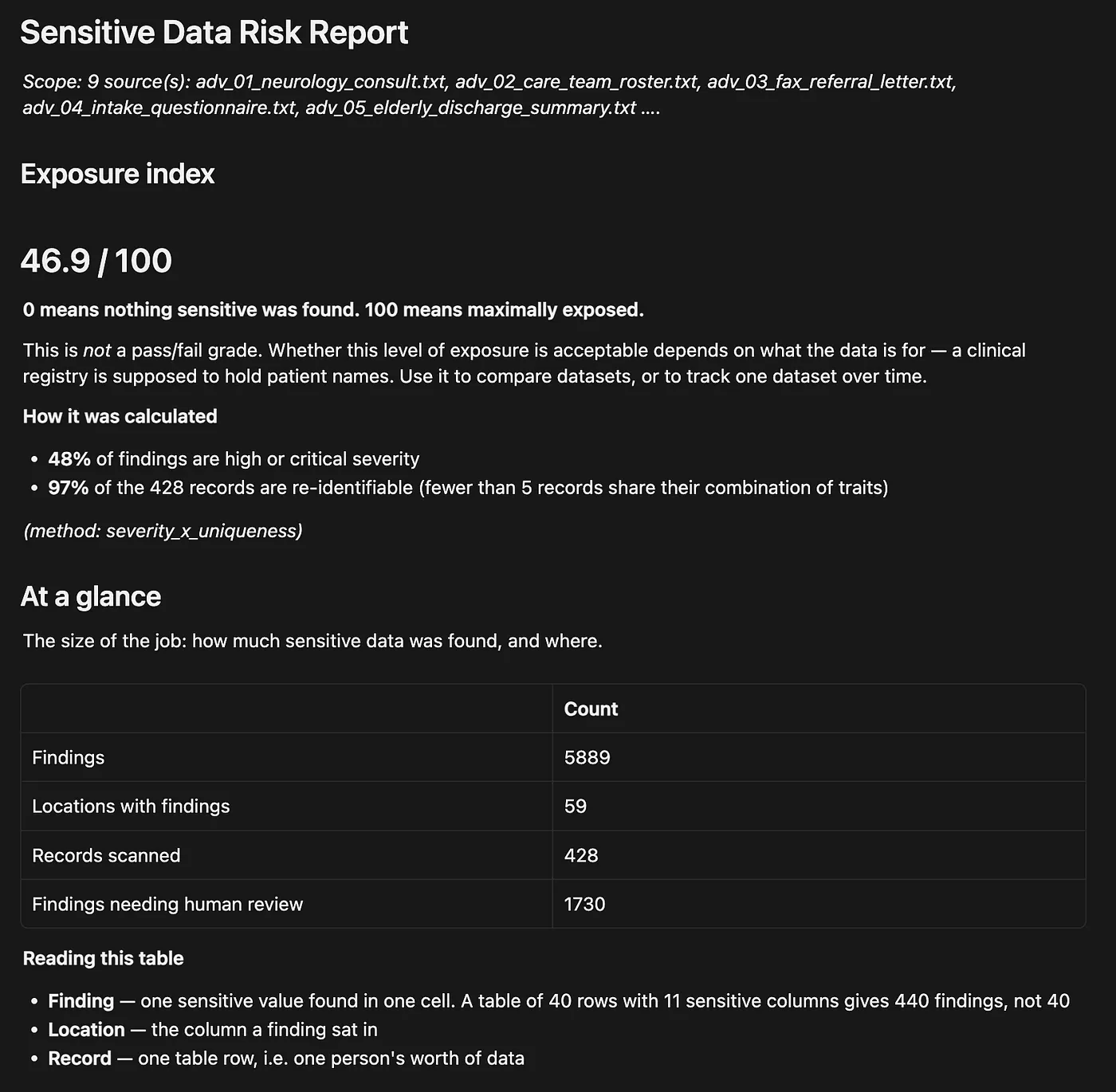
Measure privacy exposure using dataset-level metrics including severity distribution, review queues, re-identification indicators, and overall exposure.
Explain
Generate explainable findings with detector evidence, provenance, confidence, and the reasoning behind recommended privacy actions.
Optimize
Determine an appropriate de-identification strategy based on configurable privacy objectives while balancing downstream data utility.
Apply
Execute policy-driven de-identification across structured datasets, documents, and clinical text.
Measure
Evaluate residual privacy exposure together with analytical utility after transformations have been applied.
Capabilities
Privacy Risk Assessment
Move beyond entity detection by evaluating privacy exposure across entire datasets rather than individual findings.
Reports include:
Exposure Index
Severity distribution
Review queues
Dataset-level risk summaries
Re-identification indicators
Privacy heatmaps
Explainable Privacy Decisions
Every recommended action includes sufficient context to explain:
what was detected
why it was classified
which policy produced the recommendation
detector evidence
confidence
provenance
replacement strategy
This creates an auditable record of every privacy decision instead of producing opaque anonymization results.
Policy-Driven De-identification
Generate de-identification plans before modifying any data.
Policies can then be executed automatically across structured datasets and clinical documents while preserving consistency across repeated identifiers.
Utility-Aware Optimization
Not every sensitive entity requires the same treatment.
Different optimization profiles help balance privacy requirements with downstream analytical value, allowing teams to select an appropriate strategy rather than applying the same transformation everywhere.
Structured and Unstructured Data
Assess privacy risk consistently across:
CSV files
tabular healthcare exports
clinical notes
consultation reports
referral letters
narrative medical documents
using a single workflow.
Batch Processing
Assess entire directories containing a mixture of structured and unstructured healthcare data.
Generate consolidated reports instead of reviewing files individually.
Configurable Privacy Policies
Customize de-identification behaviour to match organizational or project-specific requirements.
Examples include:
retaining specific clinical concepts
generalizing dates instead of removing them
overriding default actions for selected entity types
adapting workflows for different privacy policies
Configurable Ontology
Entity definitions, severity, and default de-identification behaviour can be extended through editable ontology definitions, allowing organizations to adapt privacy assessments without changing application code.
Privacy Reporting
Generate reports that help teams understand:
where privacy risk is concentrated
which records require review
how sensitive information is distributed
recommended privacy actions
residual exposure after transformation
analytical utility after de-identification
Supported Data
Seiba Risk Scanner supports privacy assessment across both structured and unstructured healthcare data, including:
Patient datasets
Laboratory exports
Clinical notes
Consultation reports
Referral documents
Mixed document collections containing structured tables and free-text healthcare records
Privacy workflows do not end once sensitive information has been detected.
Before healthcare data is used for AI, analytics, research, or collaboration, teams still need to understand where risk is concentrated, determine how that risk should be reduced, preserve as much useful information as possible, and document every decision made along the way.
Seiba Risk Scanner was built to support that complete workflow.
Resources
Walkthrough: Structured Datasets (coming soon)
Walkthrough: Clinical Notes (coming soon)